


When analyzing product development, supply chain procurement, and material selection for the U.S. market, it is important to distinguish between three key concepts:
The primary material of the center post (e.g., stainless steel, ceramic, or engineering plastic).
The surface treatment or coating of the center post (e.g., nickel plating, gold plating, or other finishes)-this should not be conflated with the base material.
The material composition of the entire central airway assembly (e.g., some products feature a metal outer shell paired with a ceramic heating core, while others use a metal central tube combined with separate ceramic support components).
It is crucial to note that the presence of a "ceramic heating core" does not necessarily mean the center post itself is made of ceramic. When evaluating materials prevalent in the U.S. market, one should rely on the Bill of Materials (BOM), engineering drawings, or teardown analysis of the center post-not merely on marketing claims of a "ceramic core."
I. Primary Materials for Center Posts: Pros and Cons
Several types of center post designs are worth comparing for CBD/THC cartridges. Note that "postless" designs also exist in the industry; these represent a structural configuration rather than a specific material.
1. 316L Medical-Grade Stainless Steel (The industry standard; the classic choice for CCELL products)
✅ Pros
Offers stable electrical conductivity, mature manufacturing processes, moderate costs, and high yields in mass production.
High mechanical strength; resistant to bending or deformation, making it well-suited for high-speed automated oil-filling processes.
Resistant to corrosion from common terpenes; RoHS-compliant; currently the most widely shipped solution in overseas markets.
Easy to weld; offers excellent compatibility with the bottom electrode and the heating core.
❌ Cons
Generally more expensive than standard brass; the metal tube may occupy space within the oil reservoir, potentially affecting the layout of the airway and the oil chamber. When storing "Live Resin" oils-which are high in terpenes and highly acidic-for extended periods, there is a risk of trace amounts of nickel and chromium leaching into the oil; consequently, some compliant brands in California and across the U.S. may restrict the use of such hardware.
Metals can adsorb terpenes, which, over time, often leads to "flavor ghosting"-where the original flavor profile is altered or tainted.
High thermal conductivity causes heat to travel along the central post down to the base, which can make the base uncomfortably hot to the touch and accelerate the degradation of the oil.
Because these designs cannot achieve a "fully ceramic, metal-free" contact surface, they are often rejected by consumers of high-end, premium-grade oils.
Note: Cheaper versions may use 304-grade stainless steel; this is not recommended for THC oils, as they are more susceptible to corrosion by terpenes, which can cause heavy metals to leach into the product. Such hardware is better suited for standard glass-tank cartridges or applications where structural stability is the primary requirement.

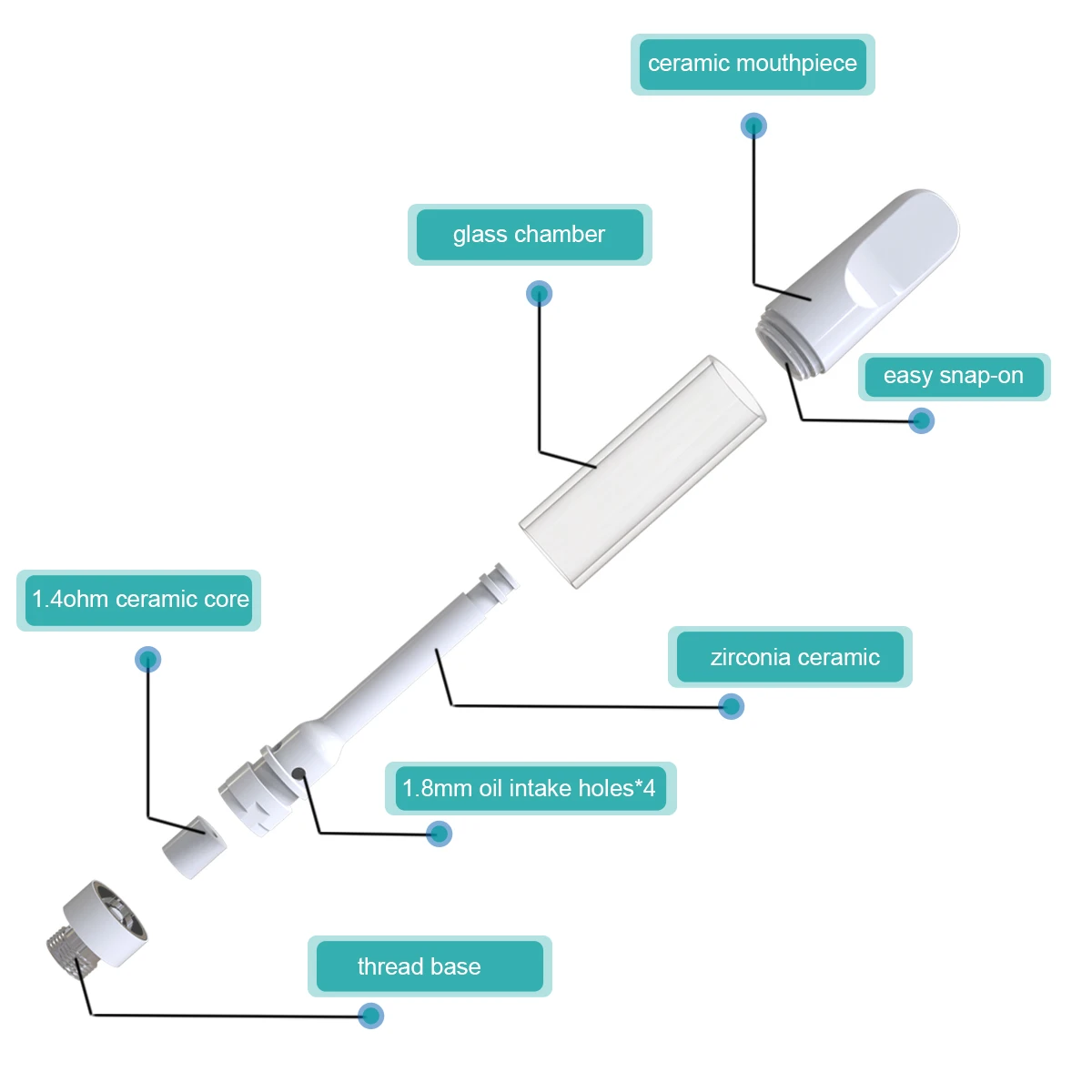
2. Zirconia (The mainstream choice for high-end, all-ceramic cartridges; the preferred option for the premium segment)
✅ Pros
Highly chemically inert-does not react with terpenes or THC/CBD oils, ensuring zero heavy-metal leaching.
Does not absorb flavors, maintaining oil profile stability over long periods; the top-tier choice for Live Rosin and Live Resin.
Electrically insulating; with proper structural design, it allows for an oil path entirely free of metal contact.
High heat resistance and thermal stability; resistant to corrosion from high-temperature vapors.
❌ Cons
Non-conductive! Pure zirconia is not electrically conductive, so a ceramic center post must incorporate an internal metal conductor (typically a thin stainless steel or titanium pin). Many users mistakenly believe "all-ceramic" implies a complete absence of metal.
Expensive to manufacture and highly brittle-prone to chipping or cracking, which leads to higher defect rates during automated assembly.
Tight tolerances are difficult to achieve, complicating the assembly process; costs are 2–4 times higher than those of stainless steel.
Cannot be welded; electrical connections must rely on crimping, which-if not executed perfectly-can result in poor contact or intermittent connectivity.
3. Brass
Common types: Copper-zinc alloys, including low-lead or lead-free variants with strictly controlled compositions.
Advantages
Excellent machinability; well-suited for turning processes and high-volume production.
Good electrical connectivity, facilitating integration with the base structure.
Offers a favorable balance between cost, manufacturing efficiency, and structural performance.
Disadvantages
Standard brass may contain lead; even when labeled as "low-lead" or "lead-free," the actual composition should always be verified.
The potential migration of copper, zinc, and other trace elements must be assessed.
Corrosion resistance varies depending on the alloy composition, surface treatment, and the specific substances with which it comes into contact.
Typical applications: Traditional cartridges that prioritize cost-effectiveness and rely on well-established manufacturing processes.
For example, the G510 CFB (a finished product) utilizes a center post made of brass with strictly controlled, low-contaminant composition, while the CCELL TH2 SE explicitly specifies the use of a low-lead brass center post.
4. Ceramics
Common types: Alumina (aluminum oxide) and Zirconia (zirconium dioxide).
Advantages
High-temperature resistance and generally good chemical stability.
Can reduce direct contact between metal and e-liquid in certain structural configurations.
Zirconia offers higher toughness and greater resistance to crack propagation compared to many conventional ceramics.
Disadvantages
Generally more brittle; susceptible to chipping or cracking due to drops, assembly stress, or dimensional deviations.
Demanding requirements for molding, sintering, dimensional tolerances, and quality inspection.
The term "ceramic" alone does not guarantee that a product will not release metals or other contaminants; the material composition, sintering quality, and actual aerosol output must still be verified.
Applications: High-end hardware, designs featuring ceramic center posts, and products aimed at minimizing direct contact between e-liquid and metal components.
Note: A ceramic heating element and a ceramic center post are two distinct components. Many ceramic heating elements currently on the market still utilize center posts made of stainless steel or brass.
5. Titanium Alloy (TC4 / GR2) Center Posts (Niche, High-End Metal Option)
✅ Pros
Features a stable passivation layer; offers superior resistance to terpene corrosion compared to 316L stainless steel, with significantly lower heavy-metal leaching.
Excellent biocompatibility; exhibits lower terpene adsorption than stainless steel, resulting in better flavor retention.
Lightweight, high-strength, and resistant to rust.
❌ Cons
Extremely difficult to machine and carries a high unit cost; rarely used in mass production.
Challenging to weld, making it difficult to securely join with other metal components.
As a metallic material, it may still result in trace metal migration-which can be detected during compliance testing in certain U.S. states-making it unsuitable for applications requiring a completely metal-free design.
6. Engineering Polymers
Examples include PEEK, PPS, and polycarbonate (PC), though these do not encompass all materials commonly used for cartridge center posts.
Pros
Lightweight and suitable for injection molding, allowing for complex structural designs.
Certain engineering polymers offer excellent electrical insulation.
Can reduce the number of metal components required, depending on the specific operating conditions.
Cons
Resistance to temperature and solvents, dimensional stability, and long-term aging characteristics vary significantly by material.
When exposed to high concentrations of terpenes, cannabis concentrates, or other formulations, the material must be evaluated for potential swelling, leaching, and changes in odor or flavor.
Standard plastics cannot be assumed suitable for use in high-temperature vapor pathways.
Applications: Suitable for low-temperature structural components, insulating parts, or elements outside the high-temperature vapor path-provided the specific material has been validated. Generally, these should not be used as a direct replacement for metal center posts without prior testing.
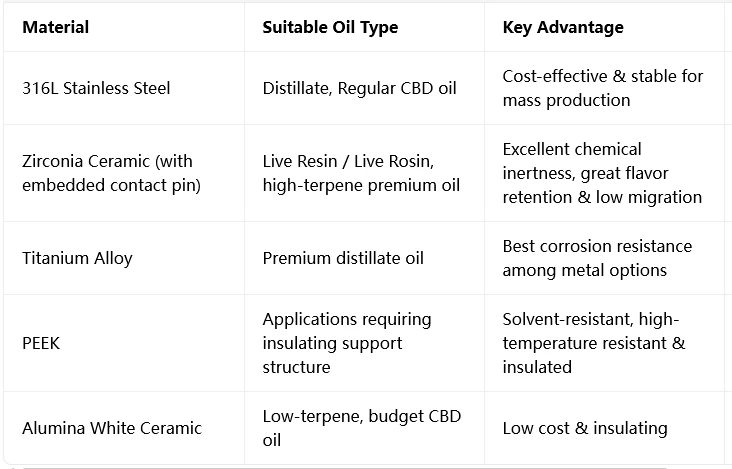
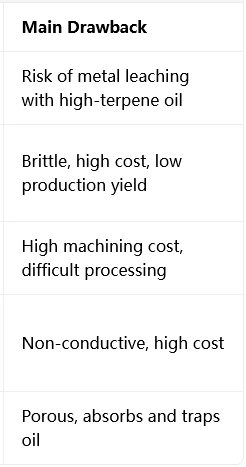
7. What are the common materials used for the center posts of 510 cartridges in the U.S. market?
Based on publicly available product specifications in the U.S. market, stainless steel and brass are the two established materials used for the center posts of 510 cartridges; ceramic center posts have also appeared in certain product lines. However, there is currently no sufficiently reliable, publicly available market share data to definitively state which material accounts for the largest percentage of the overall U.S. market.
Below are examples of specific hardware products sold in the U.S. market:
Finished Goods G510 SS
Features a 316L stainless steel center post.
Equipped with a glass oil tank, a 316L stainless steel center post, and a ceramic atomizing component-a configuration representing a mature combination of a metal center post and a ceramic heating element.
Finished Goods G510 CFB
Also features a glass oil tank and a ceramic atomizing component, but utilizes a center post made of what the manufacturer terms "Contaminant-Free Brass."
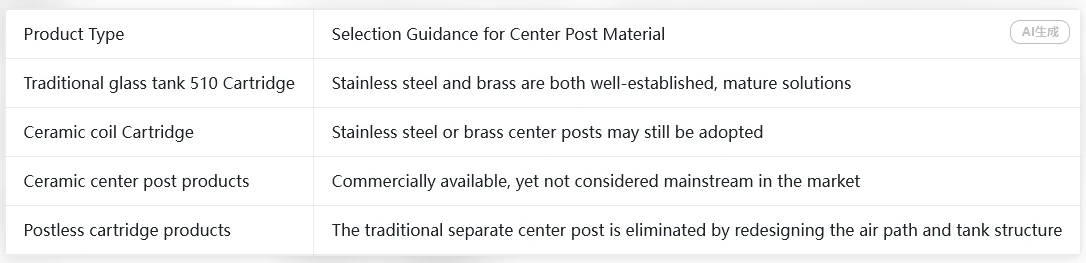
In short, if a client is producing distillate (purified THC/CBD) and is budget-conscious, prioritize a 316L stainless steel center post.
If a client is producing live resin or live rosin-especially for markets with strict regulations like California or Massachusetts-and prioritizes flavor, recommend a zirconia ceramic center post; however, be sure to clarify upfront that a thin conductive pin is still present inside.
If a client requires an oil path with zero metal contact, the only option is a "postless" design.
Avoid this pitfall: Do not use standard PC, PP, or ABS plastics for center posts that come into contact with the oil; terpenes can cause these materials to swell or degrade, leading to oil leakage and flavor alteration.