


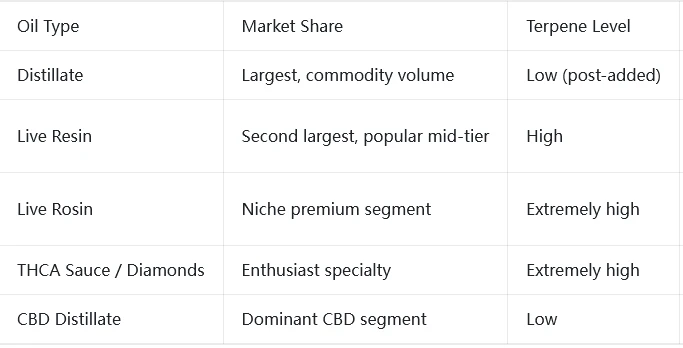
1. Distillate (The primary mass-market product; holds the largest market share)
✅ Process: Produced via molecular distillation following an initial crude extraction, isolating THC/CBD. Since the original natural terpenes are stripped away, they are reintroduced post-production (using cannabis-derived or botanical terpenes) to create specific flavor profiles.
✅ THC Content: 85%–95% (highest purity). Consistency: Viscous; fluidity improves when heated.
✅ Market Positioning: A mainstream, cost-effective product; a high-volume SKU for retail dispensary chains (brands like STIIIZY and PlugPlay rely heavily on this type of oil).
✅ Hardware Compatibility: Highly versatile; works well with 316 stainless steel center posts and standard ceramic cores.
✅ Pros: High production yield, low cost, consistent batch quality, resistant to clogging, long shelf life, and straightforward laboratory testing.
✅ Cons: Lacks original, plant-derived flavor profiles due to the reintroduction of terpenes; experienced users often find the taste artificial and note the absence of the "entourage effect."
✅ Common Customer Requests: Infusions of fruit, dessert, or strain-specific terpene profiles.
2. Live Resin (Currently the fastest-growing segment; the mainstream mid-to-high-end choice)
✅ Process: Freshly harvested cannabis flowers are flash-frozen, then extracted using a closed-loop butane/propane solvent system. This preserves the plant's native terpenes, with solvents subsequently purged/removed.
✅ THC Content: 60%–80%. High terpene content (10%–20% or more). The oil is viscous and retains the distinct, authentic flavor profile of the original strain.
✅ Market Positioning: A key mid-to-high-end product. Extremely popular in markets like California and Colorado; a core category for brands looking to differentiate themselves (e.g., Raw Garden, a benchmark brand in this space).
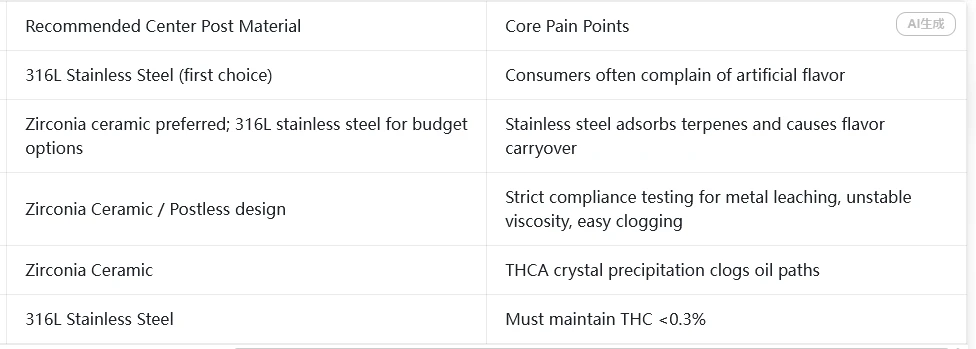
✅ ⚠️ Critical Hardware Consideration: Due to high terpene content, the oil is highly corrosive and prone to adhering to stainless steel, which can lead to flavor degradation or "ghosting" (lingering, unwanted flavors). High-end clients often specifically request zirconia ceramic center posts to mitigate these issues.
✅ Pros: Retains the authentic flavor profile of the original plant with complex, layered notes; highly favored by consumers.
✅ Cons: Higher production costs compared to distilled oil; requires precise temperature control; prone to atomizer clogging; demands specific storage conditions; greater batch-to-batch variability.
Note: "Cured Resin" is derived from dried and cured flower. It contains fewer terpenes than "Live Resin" and serves as a more accessible alternative, though production volume is generally limited.
3. Live Rosin (The gold standard for high-end, solventless products)
✅ Process: Solventless. Fresh-frozen flower is first processed into "bubble hash," then pressed under heat and pressure to extract the oil. No solvents-such as butane or propane-are used; it is a purely mechanical extraction process.
✅ THC: 65–80%. Rich in terpenes with the cleanest, most authentic flavor profile; the top choice for discerning consumers who prioritize purity and regulatory compliance.
✅ Market Positioning: Premium/high-end segment; niche boutique brands; sold in upscale dispensaries (e.g., in California). Commands the highest price premium.
✅ Technical Challenges: The extremely high terpene concentration makes it highly sensitive to hardware materials. Stainless steel can impart unwanted flavors, and there is a risk of metal leaching-a key focus for regulatory testing. Consequently, customers almost exclusively demand zirconia ceramic center posts and "postless" (metal-free) vapor paths.
✅ Pros: No risk of residual solvents; passes rigorous testing in strictly regulated states (like California or Massachusetts); offers the purest flavor profile.
✅ Cons: Very low production yield; high price point; significant viscosity fluctuations; places extreme demands on the atomizer coil, leading to higher rates of clogging and leakage.
4. Sauce / THCA Diamonds ("Terp Sauce" + THCA Diamonds)
✅ Process: A variant of "Live Resin." Through controlled crystallization, high-purity THCA crystals ("Diamonds") are precipitated and suspended within a terpene-rich liquid phase ("Sauce").
✅ Characteristics: A combination of solids (crystals) and liquids. THCA crystals can account for 70–90% of the product, while the terpene-rich liquid phase delivers an intense, explosive aroma.
✅ Market: Targeted at enthusiasts; focuses on bold flavor and high-purity THCA. Many brands offer dedicated "diamond" cartridges.
✅ Compatibility Challenge: Crystallization! At lower temperatures, the substance tends to precipitate, clogging the oil channels and the atomizer core. Manufacturers often require specialized formulations to inhibit crystallization, and the atomizer's oil channels and intake slots must be specifically optimized.
5. CBD Oil (Categorized into three types)
CBD Distillate: A broad-spectrum distillate with THC removed, retaining only CBD; the most common form.
Full-Spectrum CBD Oil: Contains trace amounts of THC (below the 0.3% federal limit in the U.S.), along with terpenes and other cannabinoids like CBG and CBN.
Broad-Spectrum CBD: THC is removed, while other cannabinoids and terpenes are preserved.
CBD oils typically have a much lower terpene content than THC "live resin," making them less demanding in terms of material compatibility-316 stainless steel components are perfectly sufficient.
Minor Categories (Rarely used for 510 cartridges; primarily intended for "dabbing"-provided here for general reference)
Shatter: Produced via BHO extraction and cooled into a glass-like, brittle substance; low in terpenes and very hard, making it difficult to fill into cartridges.
Wax / Budder / Crumble: Concentrates that have been emulsified or whipped into a paste-like consistency; their high viscosity makes them unsuitable for 510 cartridge filling.
Hash Rosin: Extracted by pressing hash made from dried cannabis flowers (as opposed to "live" frozen material); contains fewer terpenes than "live rosin."
In summary, based on client requirements:
For clients producing distillate in high volumes: Recommend 316 stainless steel center posts, as they offer a significant cost advantage.
For clients focusing on live resin/live rosin, premium brand lines, or markets like California/Massachusetts: Recommend zirconia ceramic center posts-while noting to the client that these still contain a thin, conductive metal pin inside.
For clients requiring a "zero-metal" oil path: The only viable solution is a postless (center-post-free) cartridge design.
Risk warning: For live rosin or live resin-which contain high levels of terpenes-avoid using any plastics other than specific, terpene-resistant PEEK. Materials like PC, PET, and standard plastics will swell or degrade when exposed to terpenes, potentially causing contaminants to leach into the oil.